Saturday, October 11, 2014

If You Think Its Expensive to Hire A Real Marketing and Corporate Branding Professional?

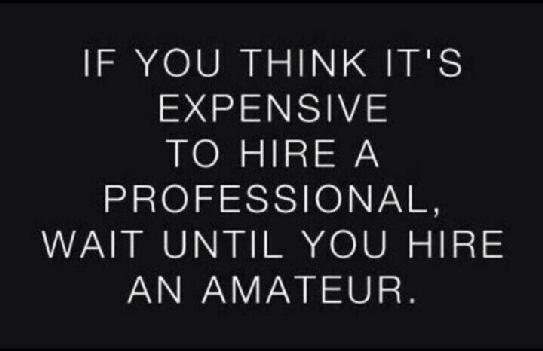
words to live by  Words to live by..If you think it’s expensive to hire a professional, wait until you hire an amateur..


Yes, every smarty pants overseeing corporate marcom budgets would like to believe that “since the cost of technology becomes cheaper, and as the cost of advertising becomes more efficient [thanks to the ad industry embracing the types of electronic trading tools that are ubiquitous across Wall Street]..there’s no need to pay  so-called madmen any premium to help frame [our] value proposition…”


Good luck with that notion.


This isn’t to suggest we advocate or fully embrace the adage “you get what you pay for.” To the contrary, if I had $10 for every frustrating experience shared with me by a client who was over-promised and over-charged for what inevitably turned out to be under-performance, I might be eligible to join the 1% crowd.


Rules of engagement: Objective advice, if only used for purposes of weighing a strategy can prove invaluable.


If You Think Its Expensive to Hire A Real Marketing and Corporate Branding Professional?

Tuesday, September 30, 2014

Rampart Asset

rampartlogo


Engaged to oversee design of new website and craft value proposition narrative on behalf of Rampart Asset Management, an alternative asset management firm owned and operated by financial industry executives who are also  certified service-disabled veterans.


Website: www.rampartasset.com


Rampart Asset

Sunday, September 14, 2014

Branding Opportunity Up-Tick For Hedge Fund Industry Marketers

2009-02-26-hedge-fund-managers As noted last week by WSJ reporter Andrew Ackerman, the hedge fund industry regulator aka CFTC has further eased restrictions on hedge fund advertising, a move that could spark an uptick in creative branding strategies within an industry long constrained by rules that could further promote their offerings.


The below opening lines of Ackerman’s story should be a call to action for HF managers who understand the need to better position their story within mediums that are known to resonate with your targeted audience. After all, the most successful and most respected firms in other parts of the financial industry have enjoyed outsized ROI by investing in cohesive and creative ad campaigns, as measured by a combination of garnered AUM and increased good will value.


“..Washington–U.S. commodity regulators took long-awaited steps to make it easier for hedge funds and other firms to raise cash by publicly advertising stakes in their funds.


The Commodity Futures Trading Commission late Tuesday eased long-standing marketing restrictions on so-called private offerings by hedge funds and other funds sold only to wealthy investors, a move aimed at aligning the CFTC’s restrictions with similar rules set by the Securities and Exchange Commission…


The bulk of the hedge-fund industry declined to take advantage of last year’s eased SEC rules, in part because many funds were still barred from public advertisements under separate CFTC rules that apply to funds that engage in derivatives trading, as many firms do. The CFTC’s move to ease those restrictions Tuesday and make them similar to the SEC’s comes after more than a year of lobbying by the hedge-fund industry.”


Jay Berkman, the principal of corporate marketing and brand strategy firm The JLC Group, whose clients include a number of financial industry firms, including global macro strategy firm Rareview Macro LLC, noted, “If I were managing a hedge fund, this would be the time I’d be tapping into firms that are creative, but also truly understand the industry landscape and the profile of the targeted audience. ” Added Berkman, “An expert that understands that it’s not about what you are selling, but about what your customers want to buy.”


The WSJ story is available by clicking this link (subscription might be required).


Branding Opportunity Up-Tick For Hedge Fund Industry Marketers

Sunday, August 03, 2014

Real Branding: Pictures Tell 1000 Words; Infographics 101; FB Selling Fish Oil

Today’s Sunday NYT Times featured a story profiling how Facebook advertising gurus are constructing an ad campaign to sell fish oil for MegaRed, a neutraceutical brand that is trying to break through the clutter within a product category that is literally swimming with products; the best take away from that story can be found in a comment courtesy of FB VP Eric Schnabel: “Great words with an image attached to them are the purest form of expression.”


Adds Schnabel: Story lines that stretch across multiple ads (ad gurus call this strategy “short-form narratives”), spread out over days or weeks, could also be very effective. “We try to make them more like ‘Law and Order’ than ‘Game of Thrones,’ ” Mr. Schnabel said. “You don’t need to see every episode in order for it to make sense.” But don’t overdo it, he warned. Ads that pop up too frequently feel like spam. Facebook itself generally aims to show one ad for every 20 items in a person’s news feed, although users who like or comment frequently on ads might see more.


In due respect to above-noted young turk, we don’t suggest that Schanbel has hit on new concept within the context of using images, he is simply regurgitating what every brand advocate should know; wisdom that we’ve espoused in this blog more than a few times during the past 8 years. That’s right, we’ve been evangelizing this notion for more than 15 minutes; most recently in our July 10 “blog post”. 


imgadTo illustrate this simple observation with just one example, in 2009, while representing a consumer product company that sought to create awareness about hand hygiene and their alcohol-free hand sanitizer, we ran the adjacent photo image in a Google ad campaign..During the first 36 hours, the ad inspired 10,000 (that’s right, Ten Thousand) click thru’s, converting into more than 1000 orders for the company’s products.


Yes, we do push the envelope when advocating clients’ brand messages. We also pound clients’ tables (and every so often, we’ve had to ceremoniously knock their heads against a wall) to drive home this critical approach to branding in a world where images have become the greatest influencers. How/why else can one explain the success of Pinterest, Instagram and of course, Facebook (among others)? How else can one explain the dramatic shift by brand marketers to mobile device advertising, a format that only “sticks” when images are the primary element?


Because it works.


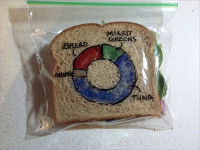
sandwich-pie-chartAnd before signing off to sun on the beach on this sunny day, this update wouldn’t be complete without making reference to the use of infographics–an approach that uses minimal words within a message dominated by a visual element. We touched on this topic in the July 10 post, but we’re compelled to grab it and shake it some more, this time with a shout out to infogr.am, one of several online sites that help marketers create a variety of informative presentations that leverage the impact of images.


Real Branding: Pictures Tell 1000 Words; Infographics 101; FB Selling Fish Oil

Tuesday, July 29, 2014

#Chatvertising: Native Content Gets a Kick from #Kik; Talk To The Bot

Kudos to WSJ’s Christopher Mims and his recent article (in which he claims to have coined a phrase that, even if its been around for at least 15 years, will undoubtedly now become ubiquitous across the corporate advertising and brand marketing universe in less time than it might take to craft a wily tweet.


First, in due respect to Christopher–if you’re reading this, you’d want to open a browser and insert the phrase “chatvertising” before you endeavor to secure a trademark or a patent. I found this definition posted to web in 2000:


The act of promoting a company, etc., by insinuating its name and/or press-release-like statements into casual online chats, discussion-groups, nodes, and the like. My employer, Immortals Inc., after a recent merger with MegaSuperCorp, announced Friday it will be launching a multi-billion-dollar chatvertising PR campaign.


But, lets not split hairs when it comes to PR industry IP; the most recent reference by WSJ’s Mims is profiling a more contemporary application: the one in which instant message communication between brand advocates and customers is actually taking place between brand-hosted “bots” (for you “newbies”, bots are merely software-contrived creatures from the world of artificial intelligence) and customers or brand fans who like to think they are engaging in a conversation with a real person. Or maybe, those who use applications such as Kik (akin to the currently more popular “WhatsApp”) are finding the computer-driven dialogue more comforting than having to communicate with a human. When considering the decline of customer service that has permeated online and brick and mortar companies, who can blame anyone for preferring to exchange dialogue with a robot?


Here’s an excerpt from Mims’ column in the WSJ (my footnotes follow accordingly):


kik“…Simply spamming users with ads in such an intimate space won’t work. Part of the problem is that until now, it hasn’t been clear what a “native” advertisement in a chat app looks like. Yet in the first week of offering its “promoted” chats, 1.5 million people opted in to one of the campaigns, according to a Kik representative. And Kik’s own chat bot, which began as an experiment and has been running for years, gets 1.8 million messages a day.


If it seems improbable that so many teens—80% of Kik’s users are under 22—would want to talk to a robot, consider what the creator of an award-winning, Web-accessible chat bot named Mitsuku told an interviewer in 2013.


“What keeps me going is when I get emails or comments in the chat-logs from people telling me how Mitsuku has helped them with a situation whether it was dating advice, being bullied at school, coping with illness or even advice about job interviews. I also get many elderly people who talk to her for companionship.”


Any advertiser who doesn’t sit bolt upright after reading that doesn’t understand the dark art of manipulation on which their craft depends.


Chat bots built by brands can be used for entertainment, but they can also be used to inform; imagine conversing with your bank or utility company’s bot when you have a customer-service question. And the ones Kik is working on can learn, says Mr. Livingston….”


The premise of course, is that artificial intelligence will continue to evolve exponentially; a valid and well-documented thesis. In the case of Kik (as in many other AI apps), the goal is to create a dynamic application that is continuously “self-learning”…so that with each interaction, the robot on the other end of the line becomes increasingly more intuitive and its responses ultimately become indecipherable from the responses one would expect from a human being.  Bringing me to a new phrase that I’ll hereby and happily hypothecate to Chris: ” human beens”…aka HBs…definition: something that was once human.


For those who remember 2001: A Space Odyssey, the article by Mims is an intriguing update:


#Chatvertising: Native Content Gets a Kick from #Kik; Talk To The Bot